Solo Flight, No Ground Control


There is a very specific brand of panic that hits when you realize your emergency contact is...
You.
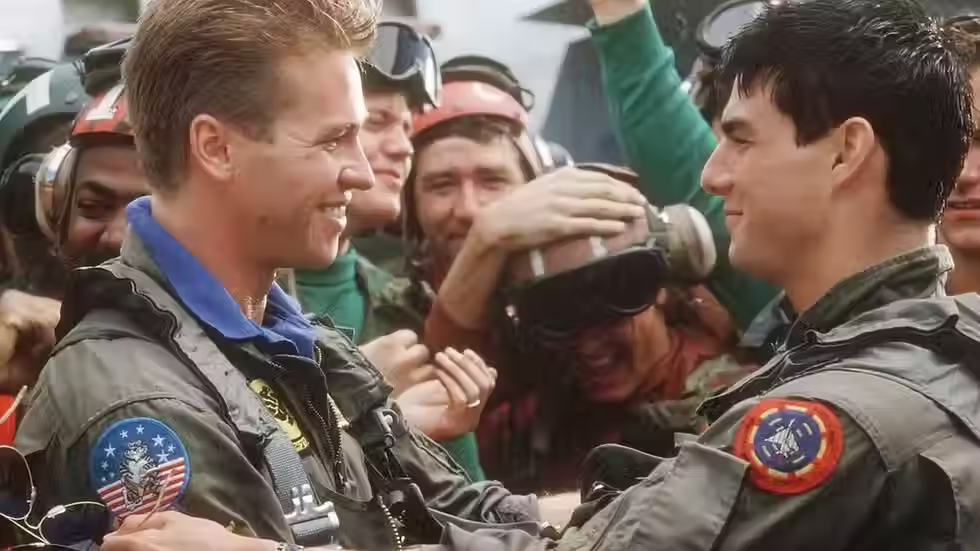
When you lose the person who grounded you, the world doesn't just feel emptier—it feels completely gravity-free. For over thirty years, I had permanent ground control. If my life were an 80's blockbuster, I would definitely be Maverick—flying entirely by the seat of my pants, pushing boundaries, and putting on a pretty chaotic cockpit performance. Greg, on the other hand, was the ultimate Iceman. He was my cool, calm, calculating co-pilot. He was the permanent partner who kept me from pulling perilous stunts.
But now?
I’m on a solo flight,
the radar is silent,
and my wingman is missing.
I have been navigating this solo flight since October 3rd, 2025, the day Greg passed away. Being a widow in the "middle" of life—too young to be done, but too seasoned to be a beginner—is a strange, unscripted reality. I am still learning how to be the pilot, the navigator, and the entire ground crew all at once.
Debriefing in the Danger Zone
The truth is, Greg’s ability to ground my wilder flight patterns wasn't a slow burn; it was obvious from the very jump. Before I met him, I had been a pretty wild teenager, always moving at Mach 2 and spinning in a dozen different directions. To put it mildly, I was a 'preacher’s kid'—so if you're picturing the movie Footloose, you are exactly on the right track! I had a lot of energy, a lot of big ideas, and a serious streak of rebel independence.
Then came Greg, the only guy who could actually talk to Maverick.
The first time I brought him home to meet my parents, my mom took one look at his steady composure, grabbed my arm, and smuggled me into the laundry room. The laundry room was our designated debriefing room—it’s where all the truly monumental, no-nonsense family chats happened. She locked eyes with me and said, point-blank:
“Jennifer Lynn. Don’t screw this one up.”
She knew. Right there, surrounded by hampers and detergent, she recognized that if I was going to fly through life with my hair on fire, I needed the guy who could look at Maverick and say, "You can be my wingman anytime." Greg was the perfect, steady balance to my chaos.
Maverick’s Instincts vs. The RIO’s Radar
And, to put it mildly, Greg was also my financial cruise control. I have always been the Maverick of the relationship—the one flying by the seat of my pants with the big, vivid, and inevitably expensive ideas. I constantly felt the need—the need for speed, travel, new projects, and pricey perks. Greg, on the other hand, was my steady "Radar Intercept Officer" in the back seat, acting as the pragmatic protector of our pocketbook.
Whenever I’d come flying into the room hot with a grand plan for a major purchase or a massive new project, he’d patiently pull out the metaphorical spreadsheet to curb the chaos and crunch the costs. He never squashed my excitement or grounded my jet; he just made sure we didn't crash the plane trying to fund it. He was my biggest supporter precisely because he kept my altitude in check and gave me his honest, unvarnished perspective.
For thirty-two years, his mantra was always the same:
'Stick with me... I’ll take care of ya!'
And he always did.
Without him, I am suddenly flying completely solo in the cockpit as the sole gatekeeper of my own life. I have to pull double duty now: executing the wild maneuvers while simultaneously analyzing every risk, tracking the gauges, and forcing myself to be my own financial voice of reason.
And honestly? It sucks. I hate it.
He was my Goose, too—the only person who truly knew how to handle my flight patterns, the one I could always look to when the cockpit got crowded, and my loyal wingman in the air and on the ground. There is nothing liberating about carrying the unrelenting weight of every final call on your own shoulders when you just want your partner to look at the navigation data and say, 'We've got this.'
Worse than that, it makes me afraid to dream big. When you don’t have your wingman there to bounce your wildest dreams off of, you start clipping your own wings. It’s hard to pull off a daring maneuver when you don't have a co-pilot to check the instruments and yell, "Talk to me, Goose," when things get turbulent.

Requesting Permission to Fly-By
But the hardest part of losing your ground control isn’t just the massive tactical decisions; it’s the total collapse of the shared flight plan. It’s the invisible net of daily logistics that keeps the whole operation from crashing.
Greg was the ultimate anchor at Hangar Home. When he was here, he’d fly back base-side for lunch every single day to let our dogs out, making sure they had love and interaction while I was clocked in at my own station. Because he was holding down the fort, I had the luxury of freedom. If I wanted to request a little extra time after work to go to the gym, run errands, or meet up with a friend to decompress, I could. My daily flight plan could be flexible because I knew the home coordinates were entirely safe and secure.
Now, that luxury has been completely stripped away. Moving forward solo on this grief journey means I am always flying on a strict, unforgiving fuel gauge. The second the clock hits 4:30, and I clear out of the tower, I can't linger, and I can't take the scenic route. I have to immediately engage the thrusters and rush straight back to base—because there is no co-pilot coming to relieve me.
Emergency In-Flight Provisions
That lack of a backup plan becomes terrifyingly real when you aren't feeling well. Greg wasn't, by nature, a traditional caretaker. He wasn't the type to sit by the bedside or fluff your pillows every five minutes—he kept his distance when bugs were flying around the cockpit. But he fiercely had my back in the way he knew how: through pure, unshakeable practicality.
Whenever I was sick, Greg made sure I lacked absolutely nothing. He would map out a run to the pharmacy or grocery store, grabbing whatever specific medication I needed, along with a mountain of the right food, snacks, and drinks. He’d stock me up completely, ensuring I had a fortress of provisions so I could just rest. He didn't have to be a nurse to make me feel entirely secure.
Now? Being sick ALONE is a whole different brand of misery.

When you’re sick as a dog, burning up with a fever, and can barely find the strength to walk across the room, doing it in an empty house is a billion times worse. It’s in those moments, shivering under the blankets, that the silence of the house doesn't just feel quiet—it feels like a complete systems failure. You look at the empty medicine cabinet and realize, "Ghost Rider, data's negative." There is no backup coming unless you drag yourself out into the elements to get it.
Guarding the Radio Static
Don't get me wrong—I am incredibly, profoundly thankful for my two adult children. They love me, they care deeply, and I know they have my back. But the dynamic has shifted into a new, complicated flight pattern. As an empty nester, the house belongs to the silence for most of the year, save for the wonderful chapters when Avery is home on break. My kids are young adults building their own independent, high-velocity lives, and I am so proud of them for it.
Because of that, I find myself carefully guarding what I share. I try my hardest not to burden them with the weight of my day-to-day survival. I don't want them spending their evenings worrying about me or feeling like they have to constantly check the radar to make sure I’m navigating the quiet. So, out of a fierce, protective love, I keep the radio static to myself.

But that creates a heavy sort of silence. When the clock hits five, reality sets in: nobody is tracking my commute, nobody is asking how my work day went, and nobody is checking my status but me—and occasionally my sweet Momma, who still keeps a watchful eye on her daughter.
It gets so quiet that I’ve actually started negotiating with the flight crew. I’m currently trying to figure out how to teach Gilligan or Scooty to ask me about my day, or better yet, run to Walmart for me! They’ve certainly got the need... the need to fetch, right? I’m just still troubleshooting the logistics of how they’re going to handle the credit card machine.

Flying on My Own Power
You don’t realize how much room you have to fly until the person holding your safety net is gone. Operating in zero gravity is exhausting. It means being Maverick and Iceman, the visionary and the pragmatist, the free spirit and the strict schedule-keeper, all at the exact same time.
I’m still flying the plane. The engines are running, and I am moving forward. I'm hitting my targets and keeping the nose up. But man, do I miss the days when I could look across the cockpit, hear him say,
"You can be my wingman anytime,"
and answer back,
"No, you can be mine."

Until then, I'll keep flying the formation solo.
To Sum Things Up
When you lose your wingman, the sudden silence from ground control is deafening. You're left staring at a cockpit full of dials and switches that used to be a shared responsibility, and the loss of that yin and yang can leave you feeling frustrated, angry, and completely off-balance.
In that moment of atmospheric interference, you have a choice.
You can let the jet go into a flat spin,
Or you can take the stick, level the wings,
And realize that you're the one flying the mission now.
It isn't easy, and the air is thin, but you stay on the throttle—because out here, there are no points for second place. And at the end of the day, I remember that my Daddy didn't raise a quitter.
Ready to take the stick? Try these flight-plan prompts:
1. Identify your Wingman Dynamic
Are you naturally a "Maverick" (flying by the seat of your pants) or an "Iceman" (steady and calculating)? Write about the partner—past or present—who played the opposite role for you, and how that dynamic kept your jet from crashing.
2. What’s Burning Your Fuel?
When you’re forced to become your own ground control, the daily logistics can drain your tank faster than expected. What is the heaviest single responsibility or daily routine you’re currently handling solo that feels like it’s demanding too much altitude?
3. What Dream Are You Grounding?
It’s terrifying to initiate a daring maneuver when you don’t have a co-pilot to check the instruments. What is one "big altitude" dream you’ve been hesitant to pursue lately because you’re afraid to fly the mission alone?


Comments